Dexlyn Aggregator & Bridge
The product job was making liquidity and assets move without making users price every hidden failure mode themselves.
Context
In a fragmented ecosystem users shouldn't need to know where liquidity sits - and a bridge is the first trust checkpoint of any new chain: can I get assets in, and can I get them back out?
What I did
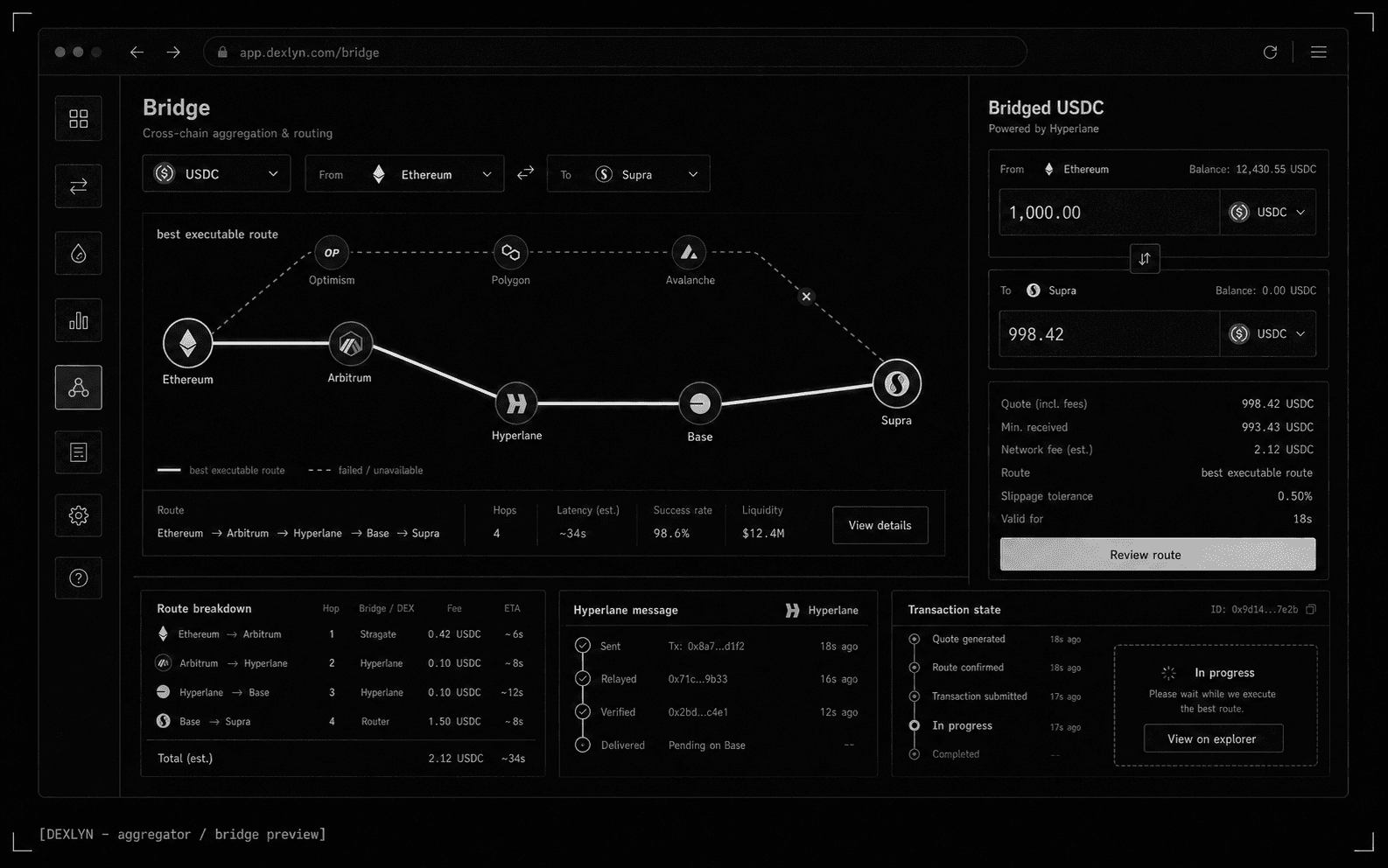
Researched and integrated Hyperlane's message-passing layer for bridge and reverse-bridge flows, including a bridged-USDC implementation via Ethereum - covering token mapping, UX warnings, transaction states, and release coordination with Supra Foundation. Led research and implementation of the multi-DEX aggregator: multi-hop routing, multi-fork order-routing APIs, quote generation, route simulation, and the Atmos DEX partnership from integration to ongoing coordination.
How it works
The aggregator core shift: from "find the theoretical best price" to "find the route most likely to execute" - pricing, depth, decimals, gas, and success analytics combined. Bridge UX is risk communication disguised as product design: what token did I receive, is it canonical, what happens if it is delayed.
Impact
Turned Dexlyn from a destination into the execution and asset-mobility layer of the Supra ecosystem.